How Quantity Surveyors Manage Bidding Risk
December 23, 2025
Construction Waste vs Contingency: Cost Control Guide (2026)
January 28, 2026
Contents
In construction and cost estimation, the term “allowances” refers to financial provisions in contract documentation for work elements that are not fully defined at the tender stage. These allowances are used to fill gaps caused by incomplete design information, material selections, or an unclear scope of work. Allowances are important because they enable clients and contractors to proceed with the project even when certain design details, materials, or quantities are unknown at the time of tendering. This article addresses the two main types of allowances: prime costs (PC) and provisional sums (PS).
Prime Cost (PC)
Based on NRM2 2nd edition, PC is defined as “a sum of money included in a unit rate to be expended on materials or goods from suppliers (e.g., supply-only ceramic wall tiles at £50/m², supply-only door furniture at £120/door, or supply-only facing bricks at £480/1,000). It is a supply-only rate for materials or goods where the precise quality of those materials and goods is unknown. PC sums exclude all costs associated with fixing or installation, all ancillary and sundry materials, and goods required for the fixing or installation of the materials or goods, subcontractor’s design fees, subcontractor’s preliminaries, subcontractor’s overheads and profit, main contractor’s design fees, main contractor’s preliminaries, and main contractor’s overheads and profit.”
PC Sums are also used for nominating specialist subcontractors for complex installations like lifts or air conditioning systems.
Crucially, the contractor cannot spend a PC Sum at their discretion; they must receive a formal instruction from the architect or superintending officer before procuring the item or entering a subcontract.
Contractor’s Profit and Attendance at Prime Cost (PC)
Prime Cost (PC) Sum covers only the net cost of the goods supplied or specialist labor; therefore, the main contractor is entitled to separate charges for their management and coordination efforts.
- Profit: At the tender stage, contractors apply a defined percentage to the PC Sum to allow for off-site overheads and profit.
- General Attendance: A lump-sum allowance covering the contractor’s general on-site support obligations, including waste removal, temporary power and water, site safety management, and provision of site offices.
- Specific Attendance: The main contractor incurs additional charges for physical works that facilitate the specialist’s installation, often referred to as Builder’s Work in Connection. This may include tasks such as unloading heavy materials, forming openings, or cutting penetrations for services.
Final Account Modifications
The actual net cost incurred at the end of the project is substituted for the original PC Sum. The contractor’s profit is then proportionately adjusted: if the true cost is lower, the profit is reduced, and if the actual cost is higher, the profit percentage is applied to the larger amount.
Numerical Example
A residential project includes supply-only ceramic wall tiles. The client has not yet selected the exact tile brand and specification at the tender stage.
Tender Stage
Supply-only ceramic wall tiles (spec not yet selected).
PC rate: £50/m²
Quantity: 100 m²
PC Sum: 100 × £50 = £5,000
Contractor’s profit (10%): £5,000 × 10% = £500
Attendance allowances:
General attendance: £300
Specific attendance: £200
Total allowed in contract: £6,000
Final Account
The final selected tiles cost £55/m².
Actual supply cost: 100 × £55 = £5,500
Profit (10%): £550
Attendance: £500 (unchanged)
Final amount: £6,550
Provisional Sum (PS)
Based on the NRM2 2nd edition, PS is defined as “a sum of money set aside to carry out work that cannot be fully described and given in quantified items in accordance with the tabulated rules of measurement. A provisional sum should be identified as either defined or undefined.”
Shifting the risk of cost adjustments for uncertain items from the contractor to the client is the main goal of a provisional sum. It is very advantageous in high-risk divisions, such as unplanned rock excavation or groundwork.
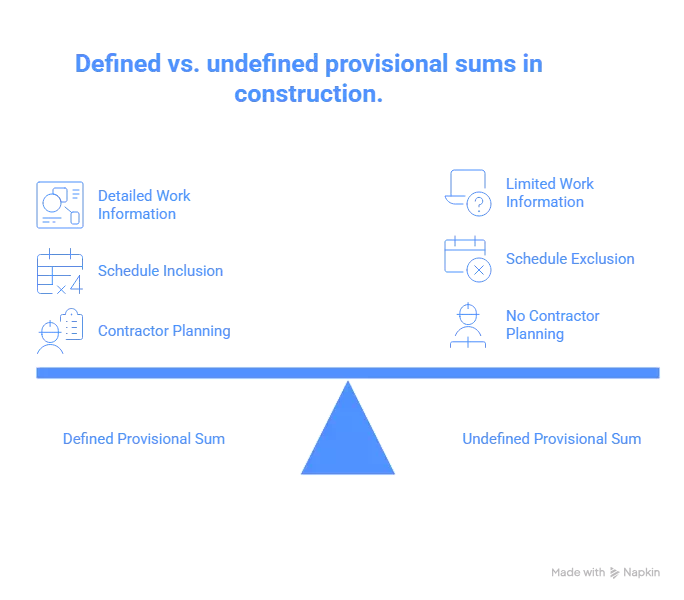
Defined Provisional Sum
Based on the NRM2 2nd edition, a defined provisional sum is “ a sum provided for work that is not completely designed but for which the following information is provided:
- the nature and construction of the work
- a statement of how and where the work is fixed to the building, and what else should be fixed.
- a quantity or quantities that indicate the scope and extent of the work.
- any specific limitations, etc., identified.”
These should have been allowed for within the contractor’s original schedule. Although the exact value may be provisional, the contractor is expected to plan and sequence the work in their baseline schedule.
undefined Provisional Sum
Based on the NRM2 2nd edition, an undefined provisional sum is “A sum provided for work that is not completely designed, but for which the information required for a
defined provisional sum cannot be provided.”
These are placeholders for unforeseen works because the nature of the work is unclear at the time of tender. These sums are only expended if the work proceeds under a later instruction. In such cases, the contractor is not deemed to have included this work in their original planning or timeline.
Execution and Measurement
A provisional sum is only expended if the work proceeds in the direction of the client’s representative.
After the task is completed, it is evaluated using one of two techniques:
- Remeasurement: Using rates from the priced Bill of Quantities, the quantity surveyor measures the actual work on-site.
- Daywork: The method of valuing work on the basis of the time spent by the contractor’s team, the materials used, and the plant employed.
Quantity Surveyor’s Role in Final Account Reconciliation
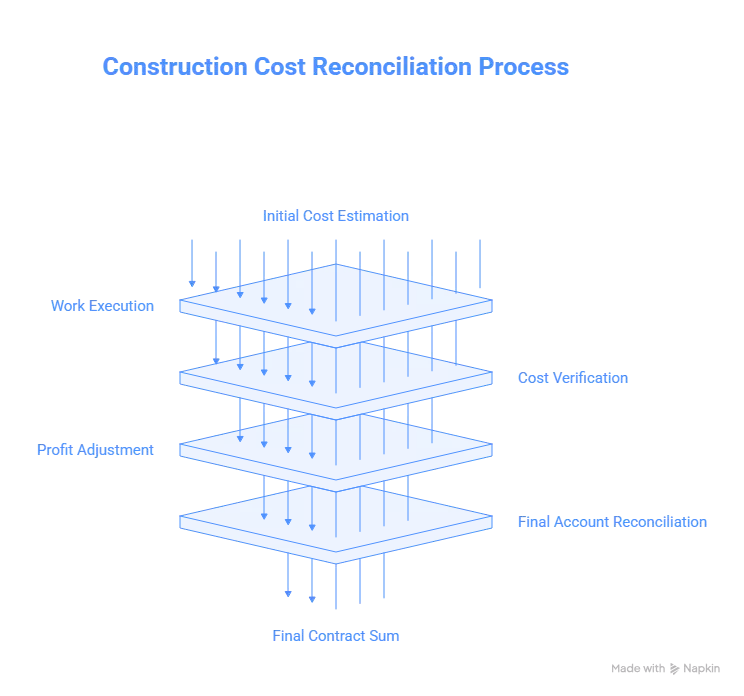
Financial reconciliation is carried out using a dynamic reconciliation process, led by the Quantity Surveyor (QS). The QS ensures that the final contract sum is based on actual, verified costs, rather than provisional or estimated allowances.
Inclusion and Omission of Allowances
To reconcile the contract sum, the QS adheres to a rigorous two-step process:
- Omission: The original budget allowance (prime cost or provisional sum) is omitted from the contract value.
- Addition: The actual, verified cost of the work is then reinstated in an organized and auditable manner.
Verification and Related Information
To support this process, the contractor must provide all relevant documentation, including:
- Measurements
- Supplier invoices
- Receipts and supporting records
For prime cost sums, the QS verifies the actual net cost and ensures that the contractor’s profit and attendance are correctly adjusted or omitted in accordance with the contract.
For provisional sums, the final value is established by the QS through remeasurement or daywork verification, depending on how the work was instructed and executed.
Conclusion
In the event of unforeseen conditions or design changes, the use of prime cost and provisional sums provides an essential “repair fund” or “weather budget,” allowing projects to continue uninterrupted.By utilizing these options, the industry may be able to strike a balance between the need to start projects early and the need for transparent pricing and equitable compensation. Because of the quantity surveyor’s careful supervision, the Final Account ensures that the customer only pays for what is actually completed, protecting the contractor from financial risks associated with the unknown.
Need clarity on prime cost or provisional sums in your project?
Our quantity surveyors can review your BOQ, identify risk allowances, and protect your final account.
Contact us for expert cost advice.