SMM7/NRM2: The Key to Accurate Tendering
December 7, 2025
Prime Cost & Provisional Sums Explained in Construction
January 4, 2026
Large-scale engineering and construction projects often require unpredictable funding and long-term financial commitments. The primary obstacle preventing contractors from profitability is competitive bidding risk, which is the financial uncertainty between the bid price and the actual cost of project completion.
The profit margin may be reduced if actual costs surpass the tendered price because of unforeseen circumstances, such as unknown site conditions, changes in material pricing, or design modifications.
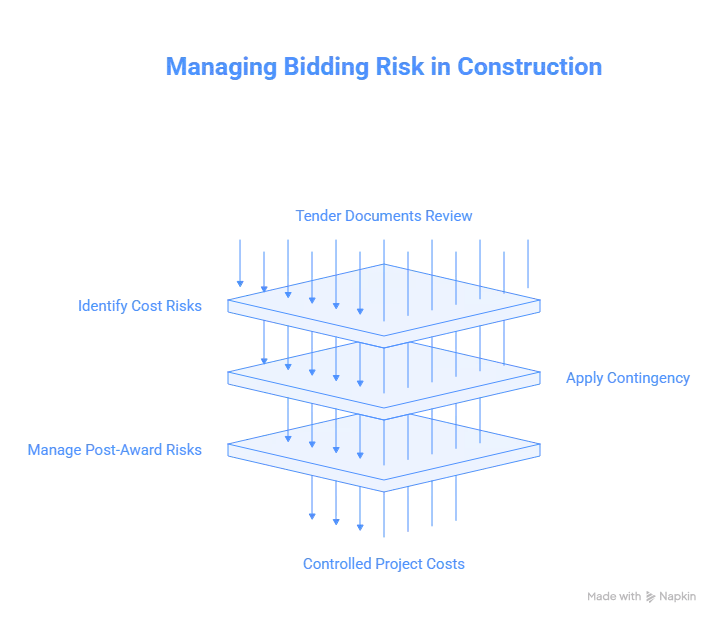
In this article, we explain how quantity surveyors can reduce risk by applying a structured three-phase risk management approach.
Phase 1: Identifying Cost Risks in the Tender Process
In this phase, the QS –Quantity Surveyor– checks for quantification errors and conducts a detailed review of all tender documents, including the BOQ, specifications, and drawings, to identify any unclear or incomplete scope items.
Tender Documents
The first step is to evaluate the completeness and clarity of the tender documents. The QS’s role is to assess whether the design information is detailed enough to accurately determine fixed quantities for a firm lump-sum tender.
- Flagging Design Risk: The QS must flag any incomplete or inadequate design information, as insufficient documentation poses a cost and commercial risk for the contractor, who needs complete information to produce accurate estimates.
- Unclear Contract Terms: The QS reviews the contract documents for unclear wording. If the contractor fails to identify these ambiguities during the tender stage, they could potentially lead to scope growth without additional payment.
Provisional Sums
Provisional sums are used to account for work where the scope or cost is unknown during the tender stage. The QS needs to look at each provisional sum to figure out what the cost risk is.
- Provisional sums are included where the works cannot be defined or measured at the tender stage due to incomplete design information, or where measurement can only be undertaken once work has commenced (for example, pending geotechnical investigation results).
- The QS must highlight the risk associated with undefined provisional sums, particularly in civil works, where they often carry a high level of cost uncertainty, even when the client instructs that a fixed provisional amount be included in the tender.
Provisional sums may permit the client some leeway in pricing, but the contractor is still at risk for program, resource, and interim costs until the scope is fully defined and valued.
Measurement basis
To evaluate the financial commitment and any need for remeasurement, the QS examines the methodology used to calculate the numbers.
- Where an early tender is issued with incomplete design information, the tender may be based on a bill of approximate quantities. This represents a significant commercial risk, as the works will require remeasurement of the actual quantities executed, which may materially change the final contract sum and increase the need for variation control and additional commercial management during construction.
Phase 2: Contingency and Mitigation Strategy
When a QS identifies ambiguities, such as incomplete documentation, unclear scope, or provisional sums, the correct professional approach is to include a contingency within the tender price. This allowance manages potential cost fluctuations arising from uncertainty and ensures that unidentified risks are priced in a controlled and transparent manner, protecting the contractor’s financial position. It is important to note that contingency excludes major scope changes, management reserves, and extraordinary events like natural disasters or major strikes. Contingency should not be confused with contractor margin, overhead recovery, or management reserves, as this specific allowance is intended solely to address the identified pricing uncertainty at the tender stage.
Contingency Analysis Models
Contingency analysis is typically divided into two primary frameworks:
- Strategic Analysis: This approach evaluates the overall maturity of the project definition and technical complexity. Lower project maturity typically corresponds to early design stages, such as conceptual or schematic design, during which the scope definition remains limited. The contingency is calculated as a percentage of the project’s total cost.
- Detailed Analysis: this type of analysis focuses on the accuracy range of individual components or specific groups of estimate line items to calculate overall risk.
The estimate classes referenced are aligned with internationally recognized cost-estimate classification systems commonly used in early-stage and detailed project estimating.
Example 1: Strategic Risk Analysis
This model evaluates the maturity of the project documents. It uses a “multiplier” based on how complete the design is.
Data:
- Base Estimate: $1,000,000
- Design Maturity: 30% complete (Schematic Design)
- Complexity: High (contains specialized cold-storage units)
- Standard Strategic Percentage: Class 3 Estimate (+15% to +25%)
Calculation:
Because the design is early (30%) and technical complexity is high, the estimator chooses the upper end of the strategic range (20%).
- Contingency Amount: $1,000,000 X 20% = $200,000
- Total Strategic Budget: $1,200,000
Example 2: Detailed Risk Analysis.
In this model, we apply a specific risk percentage to each individual work package based on its unique challenges.
- Total Project Budget: $1,069,500
- Effective Contingency Rate: 6.95%
Phase 3: Managing Risk After the Contract Award
The QS and the contract manager collaborate to create formal contractual procedures for cost recovery in order to transition from risk pricing to risk management after the bid is secured. Effective post-award risk management also relies on timely notices, accurate records, and compliance with contractual procedures to preserve entitlement. One way to manage the risk of competitive bidding is through the contractual framework.
Variations
The project team continuously monitors all scope changes. To prevent uncompensated work resulting from verbal requests, the Quantity Surveyor (QS) ensures that no changes are implemented without formal, written instructions from the authorized client representative.
Claims Management
Any requests for pricing adjustments must be submitted by the QS, who will either apply contractually billed rates to the amended quantities or compare the updated rates with the contract’s terms and any supporting paperwork, like subcontractor bids, to ascertain the adjustment’s worth.
Many post-award claims originate from risks identified, priced, or underestimated during the tender stage.
Common Claim Types:
- Client-Directed Change/Variation: This results from a dispute over time, cost, or impact of change that the client requested, which was not in the original scope of work.
- Constructive Changes/Variations: These arise from owner actions or inactions, such as unclear specifications or incorrect contract documents, that mistakenly push the contractor to carry out additional work.
- Differing site conditions: These are encounters with latent physical conditions that are either reasonably foreseeable or materially different from what was specified in the contract, like unexpected hazardous waste discovery.
- Directed Suspension of Work: This is when a clear written directive is given to suspend part or all of the project work for their convenience.
- Constructive Suspension of Work: An accidental work stoppage caused by a client’s delay, such as failing to grant site access promptly or approve crucial shop drawings.
- Force Majeure: Requests for time extensions because of unpredictable circumstances outside of both parties’ control, like natural disasters, war, or exceptionally adverse weather.
- Directed Acceleration: A clear directive to finish tasks ahead of schedule.
- Constructive Acceleration: This happens when the client denies an acceptable time extension for an excused delay, forcing a contractor to rush to meet an initial deadline.
Conclusion
Bidding risk cannot be eliminated, but it can be effectively managed using a structured quantity surveying methodology. Quantity surveyors contribute to contractor profitability and cost certainty by identifying tender risks early on, applying appropriate contingency allowances, and enforcing strong post-award cost control. A disciplined risk management framework converts uncertainty into a controllable and manageable component of the bidding process.
Need support managing tender risk and improving bid accuracy?
Our quantity surveying and construction estimating services help contractors identify tender risks, apply accurate contingency allowances, and protect profitability from the bid stage through project delivery.
Contact us today to discuss your next tender.