
Earthworks Essentials: Cut, Fill & Costing
November 23, 2025
SMM7/NRM2: The Key to Accurate Tendering
December 7, 2025
Contents
The Cost Breakdown Structure (CBS) is a fundamental approach in project management and construction estimation for describing and arranging the overall cost of a project. The CBS provides the fundamental foundation for pricing, tendering, and resource planning by breaking down the entire scope of work into fundamental, quantifiable components, ensuring that all cost inputs are appropriately accounted for.
Every project activity bases its CBS on the three fundamental pillars of direct cost: material, labor, and plant (equipment). The “Contract Sum,” or total project cost, is the sum of these three direct costs plus any indirect costs.
Material: Waste and Order Quantity
Material costs, which include the actual items used in the project, make up most direct project costs. The quantity surveyor (QS) or the estimator should fully understand there is a difference between the quantity measured for billing and the quantity that must be ordered from the supplier.
Net vs. Gross Quantity
Net Quantity (Measured Quantity): This value is the precise, calculated amount of material required to be physically placed or fixed in the structure. In the Bill of Quantities (BOQ), this net quantity, or the amount installed “as-built,” is what the contractor uses to calculate the unit rate.
Gross Quantity (Order Quantity): is the total quantity of material that needs to be bought from the supplier. The gross quantity is derived by taking the net quantity and adding an allowance for wastage. It is crucial for the estimator to perform pricing at the gross quantities level, as this signifies the actual cost that will arise.
The Role of Wastage Allowances
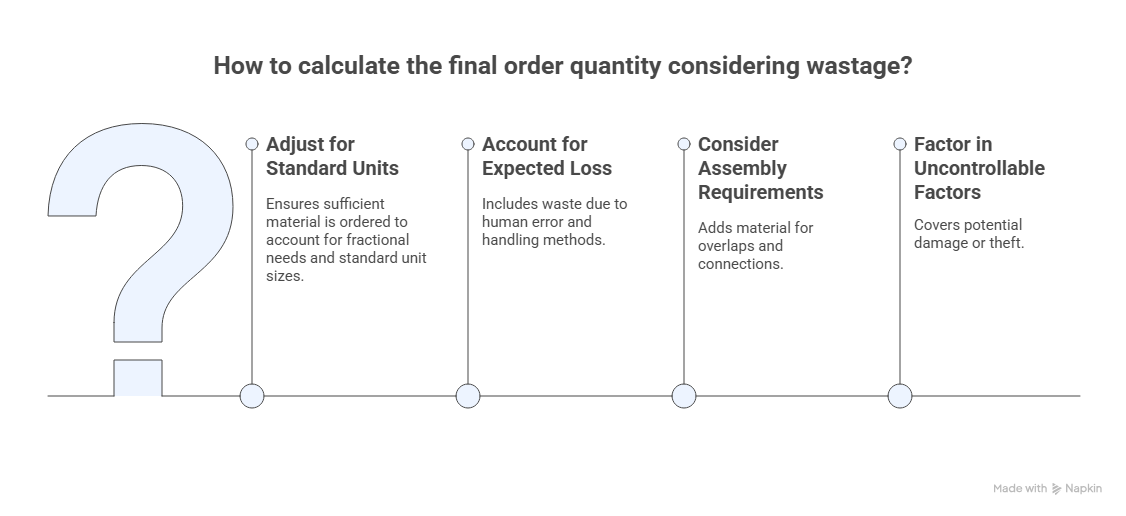
A wastage allowance is a fundamental consideration applied only to materials, never to labor, and stems from several factors:
- Adjustment to Standard Sales Units: Materials are typically not sold in the exact fractional quantity needed. When products are purchased in standard units (e.g., lengths of lumber, rolls, or bundles), the unused portions, or falloff, must be included in the purchase order.
- Expected Loss: Waste is a result of human error, handling, and placement methods. For instance, concrete poured in formwork usually has a loss tolerance of 1% to 5%, which increases to around 10% when concrete is poured directly against soil. Some items have higher waste tolerances, such as filling with sand, due to material workability and compaction.
- Assembly requirements: Some assemblies require extra materials for overlaps, such as vapor barriers, or connections, like electrical cables.
- Uncontrollable Factors: The final order amount must account for uncontrollable problems like weather-related damage, breakage, or site theft.
The estimator determines the final order quantity by multiplying the takeoff quantity by the relevant waste factor. For bulk materials like gravel or sand, this factor must also consider the compaction factor needed to achieve the desired density on-site, making sure that the ordered volume is adequate for the final compacted volume.
Labor: Predicting Output and Actual Cost
Labor cost is the total expense of paying workers for the time and effort they spend completing a construction task. Unlike material, labor is highly subject to external and internal conditions, making the accurate forecasting of productivity the greatest challenge for the estimator.
The True Cost of Labor (Gross Labor Rate)
The gross labor rate, or billing rate, significantly exceeds the employee’s base wage (“in the envelope pay”), representing the true cost of an hour of labor.
The estimator must determine the overall burdened labor cost by adding several required and optional employer payments:
Statutory expenses (insurance and taxes):
These necessary expenses, which are deducted from gross wages, include:
- the Social Security tax (FICA).
- the Federal and State unemployment taxes (FUTA and SUTA)
- worker’s compensation insurance.
The contractor’s experience modifier—a safety record that directly affects competitiveness—adjusts the variable worker’s compensation premium, which is frequently calculated as a percentage of gross wages.
Numerical example:
Assume a worker earns $1,000 as gross wages per week. The statutory expenses will be calculated as in the following table:
For a worker earning $1,000/week, the employer pays $167.50 in statutory costs (insurance + taxes) on top of wages.
Benefits and Fringe Costs:
Contributions for retirement, health insurance, paid time off, and vacation pay are factored into the hourly rate.
Overhead and Profit:
To arrive at the final billing rate, the contractor must allocate a share of general business expenses (indirect overhead) and assign a percentage for profit to the total burdened cost.
This detailed calculation transforms a base wage into a gross billing rate, representing the actual dollar investment required to purchase one hour of field time (e.g., from $25.00/hour to over $48.00/hour).
Forecasting Productivity (Output Rate)
Productivity is defined as the rate at which work is produced by an individual or crew per unit of time (most often measured per day). This rate converts the project’s BOQ quantity into the total labor hours required.
Since the entire gross labor rate is charged for a single labor hour, any inaccuracy in the productivity estimate is amplified, resulting in a substantial cost difference.
The contractor’s own historical cost data provides the most accurate productivity data by recording the actual labor hours spent on particular tasks from previous jobs.
In the absence of internal records, estimators rely on publicly available industry data, which they must significantly modify through expert opinion.
Productivity rates are so sensitive, and they must be adjusted for specific labor and job factors:
Plant: Equipment, Tools, and Efficiency
The estimator must account for the cost of all the machinery, equipment, and tools required to finish the work item. The importance of this cost stems from the direct relationship between the productivity of the labor component and the efficiency of the employed plant. (e.g., using a powered hoist increases brickwork installation speed)
Typically, there are three categories for plant expenses:
- Major equipment (capital items), such as cranes, excavators, and hoists. This is valued based on the specific duties it facilitates. The cost is calculated by applying a rental rate or an ownership cost (including depreciation, financing, taxes, insurance, and maintenance) against the estimated hours the equipment is required on site.
- Renting equipment (hire). It is a smart choice for short-term or specialized needs. The estimator has to verify if the rental rate includes or does not include operator, fuel, maintenance, and delivery fees.
- Small Tools and Consumables: Hand tools and replacement drill bits are examples of minor products that are typically not priced individually. Their cost is recovered via a small percentage add-on applied to the total labor cost of the estimate (e.g., 6%).
Assembling the Net Unit Rate
The ultimate goal of the cost breakdown structure (CBS) at the task level is to determine the Net Unit Rate (or Unit Price). This rate is the total cost required to produce one unit of work (e.g., one square meter of brickwork) before the addition of corporate overhead and overall project profit.
Numerical example:
The following example shows how the three elements are combined to determine the unit rate for one cubic meter (m³) of bulk excavation:
Net Unit Rate = Material Cost (M) + Labor Cost (L) + Plant Cost (E).
The contractor would enter £ 60.71 as the unit rate for the excavation item in the BOQ in this scenario. This pricing includes all of the work’s direct, unburdened manufacturing expenses.
After determining the net unit rate, estimators add overheads and allowances to arrive at the all-in rate, which represents the final selling price. For more details on this calculation, please refer to this article.
conclusion
The precise net unit rate for each work item is determined by the cost breakdown structure through a thorough investigation of materials, labor, and plants.
Estimators need to allocate plant and equipment costs, account for productivity factors, and accurately calculate the burdened gross labor rate to calculate gross order quantities.
To offer the accuracy required for project success, the estimation approach meticulously measures these three direct cost elements.
Are you seeking to optimize your estimating process? AwardedBid provides detailed CBS-based estimates with complete material, labor, and plant breakdowns. Contact us now.