
Who Is a Quantity Surveyor? Roles, Responsibilities & Career Path Explained
October 5, 2025
Direct Costs: Material, Labour & Plant
December 1, 2025
Contents
This article will discuss key earthworks essentials and their direct impact on contractor profit margins. Accurate project pricing depends on correctly quantifying the required amounts of soil and ground materials.
These activities can be broadly divided into two groups:
- Cut (excavation), which involves removing material to decrease site levels.
- Fill (embankment), which involves adding material to raise levels or backfill voids.
The quantity surveyor should accurately measure these quantities to support the project’s overall performance and ensure the contractor’s financial stability.
Connection Between Profitability and Measurement Accuracy
Because of the substantial risks and high costs related to ground conditions, accuracy in earthwork quantity surveying is crucial.
To determine the total contract value, the contractor applies unit rates to the measured quantities listed in the Bill of Quantities (BOQ).
These unit rates must cover all expenses for labor, equipment, and materials.
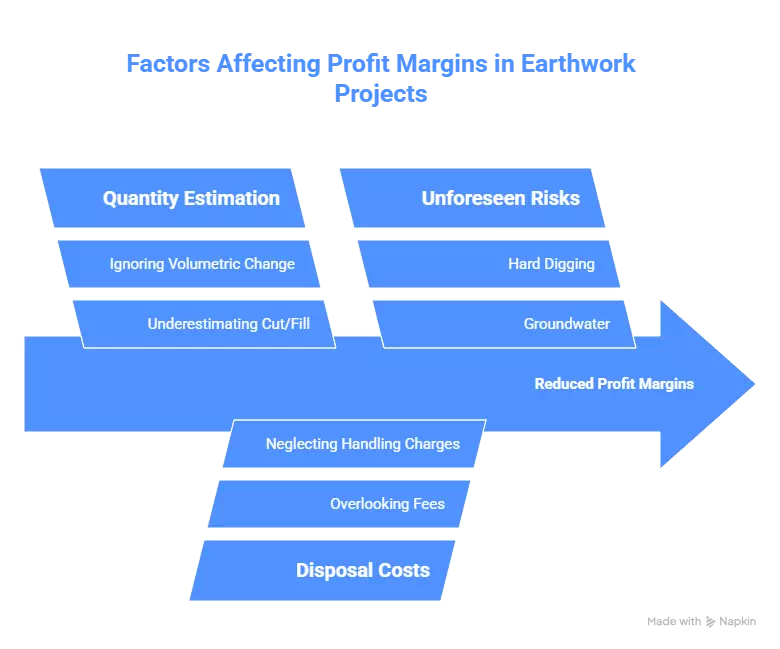
Profit margins can be reduced in several ways:
- Underestimating cut/fill quantities: Ignoring volumetric change factors can lead to purchasing or transporting more material than budgeted, directly impacting profit margins.
- Overlooking disposal costs: Failing to account for fees, taxes, and handling charges associated with disposal can severely risk profitability.
- Neglecting unforeseen risks: If the contractor does not properly price the risk of encountering costly “extra over” items such as hard digging (rock), groundwater, or contaminated soil, this can lead to significant budget overruns.
Volumetric Change: Bulkage and Shrinkage
As an estimator or quantity surveyor, you must account for the volumetric changes that occur when soil moves from its natural, undisturbed state, which is known as Bank Volume (vb)
We will discuss two main factors that influence the cost of earthworks:
Bulkage (Swell) Calculation:
Bulkage is the increase in volume when soil is excavated and becomes looser. This increase is quantified by the Swell Factor (Sf).
The following table provides the swell factor (Sf) for some common soil types:
Excavation quantities are measured net in place as Vb, with no allowance for bulkage included in the BOQ. The contractor must include an allowance in their unit rates to cover the cost of handling and disposing of the larger, bulked volume (VL)
V_L = V_b \times (1 + S_f)Shrinkage (Compaction) Calculation:
Shrinkage is the volume decrease that occurs when loose fill material is consolidated to achieve the required Compacted Volume (Vc). This is important for calculating how much extra material (wastage allowance) must be imported.
Filling quantities are measured net in place as the final Vc, with no allowance for shrinkage in the BOQ. Contractors must add a wastage allowance to their unit rates for imported fill.
For instance, a 50% waste allowance means purchasing 1.5 cubic meters of loose hardcore for every 1.0 cubic meter of required compacted volume.
V_L = \frac{V_c}{1 - R_f}Where R_f is the decimal Shrinkage Factor.
Methods for Quantification:
Quantity surveyors employ several techniques to determine earthwork volumes, primarily based on the geometry of the project.
The Grid Method:
The Grid Method is a helpful method for estimating the amount of bulk excavation or fill that will be needed to remove topsoil or prepare a sloping site to a constant Reduced Level (RL) over a wide, defined area.
How to quantify in this method:
- determine the final required RL and the excavation depth (D) at each grid point.
- Average Weighted Depth: Apply specific weighting factors (W) to the calculated depths based on location (Corner W=1, Intermediate Boundary W=2, Internal W=4).
3.The final volume (V) is the average weighted depth multiplied by the total plan area (A) of the grid.
V = \bar{D} \times AThe cross-sectional method:
It is a common method along linear features like infrastructure, such as roads, railroads, ditches, and pipelines. When the cross-sectional area varies with length, cuts and embankments can have their volumes precisely calculated using this method.
How to quantify in this method:
Calculate volume based on the Simpson Rule.
To use Simpson’s Rule for volume, you first need to have the cross-sectional areas (A₀, A₁, A₂, …, Aₙ) calculated at equally spaced intervals along the length of the solid.
The formula is applied to a series of an odd number of cross-sectional areas (meaning an even number of intervals).
V = \frac{h}{3} [ (A_0 + A_n) + 4(A_1 + A_3 + \dots + A_{N-1}) + 2(A_2 + A_4 + \dots + A_{n-2}) ]Where:
- V is the total volume.
- h is the common interval (distance) between the cross-sectional areas.
- A₀ is the first cross-sectional area.
- An is the last cross-sectional area.
- 4(A1 + A3 + …) is four times the sum of the even-numbered areas (areas with odd subscripts, e.g., A1, A3, A5).
- 2(A2 + A4 + …) is Twice the sum of the odd-numbered areas (areas with even subscripts, e.g.,A2, A4, A6).
The number of cross-sectional areas (n+1) must be odd, which means the number of intervals (n) must be even (e.g., 2, 4, 6, 8, …).
The distance between all consecutive cross-sections must be equal.
Pricing Considerations:
The unit rate for any earthwork item is calculated from first principles—a detailed breakdown of labor, plant, and material costs. This calculation must clearly distinguish between permanent components and temporary supports.
Permanent Work (e.g., Topsoil Excavation)
Permanent work, like topsoil removal, is often measured in superficial m² (at a specified average depth) or cubic m³ for bulk volume.
- Unit Rate Calculation: The m² rate covers the labor and plant to excavate and load the topsoil, derived from the combined hourly cost divided by the output per hour.
- Disposal: Disposal is a separate cubic item (m³). Even though the measurement is net, the contractor must factor the cost of handling the bulked volume into their disposal rate.
Temporary Work (e.g., Earthwork Support/Shoring)
Earthwork Support (E.W.S. or shoring) is a temporary work item measured in superficial m² and categorized by depth. It must be measured if the depth exceeds 250 mm, reflecting the inherent safety risk.
- Labor: Includes the cost of the operative for both fixing the support and subsequently striking (removing) it.
- Materials and Reuse: The concept of material reuse is taken into account when calculating the cost of materials.
If a board is expected to be used four times, only one-quarter of its gross cost is allocated to the current unit rate. Additionally, waste and repairs are taken into account.
\textit{Effective Material Cost} = \frac{\textit{Gross Material Cost}}{\textit{Anticipated Number of Uses}}This clear separation ensures the contractor is paid fairly for both the permanent works and the cost of maintaining a safe working environment.
Conclusion
The accuracy of quantity surveying is crucial to the financially effective completion of earthworks. To achieve this accuracy, proper volumetric adjustments must include allowances for shrinkage (compaction) of imported fill, which can be up to 50% for hardcore, as well as considerations for bulkage (swell) when pricing spoil disposal. For area-based bulk excavation (site strips), the Grid Method is utilized, while for linear features (roads, trenches), the Cross-Section Method is employed. This method allows for precise volume calculations using formulas like Simpson’s Rule.
Contact us for expert advice.