CSI MasterFormat: A Framework for Construction Specifications
November 25, 2024
Earthworks Essentials: Cut, Fill & Costing
November 23, 2025
Contents
The Quantity Surveyor (QS), who oversees cost, commercial, and contractual aspects, is critical to the success of any construction project. Whether serving as the client’s cost consultant (PQS) or a member of the contractor’s team, the QS ensures financial stability and effective control throughout the project.
They manage cost control and reporting, contracts and commercial obligations, and procurement to ensure that suppliers and subcontractors provide the best value. Their technical expertise in measurement and estimation enables precise budgeting and tendering, while their proactive oversight of costs, claims, and contractual compliance reduces financial risk.
Key Roles within Quantity Surveying
The QS role has developed since the late 18th century, expanding from mere “measurers” to professionals adept at administering contractual and commercial aspects of projects.
Professional Quantity Surveyor (PQS)
The PQS operates as the client’s cost consultant and cost manager and is considered a member of the design team.
His responsibilities vary according to the project stage:
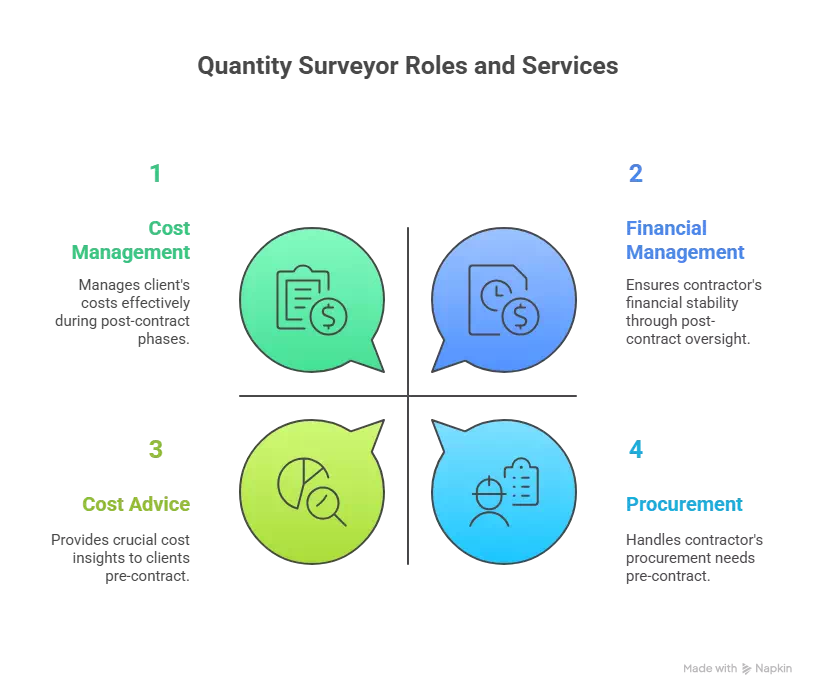
Pre-contract services: providing cost advice, estimating construction costs for budgeting (often based on rudimentary designs), monitoring costs throughout design development, and preparing trade bills of quantities (BOQ) for tendering.
Post-contract services: cost management, financial certification for interim payments, valuing changes to the works, and preparing the final account. Large consultancies offer augmented services like recommending procurement routes, risk management, and acting as the client’s or employer’s agent.
Contractor’s Quantity Surveyor
The contractor’s QS is a commercial member for the supply side, integrated into the main contractor’s operations. The primary focus is commercial, administrative, and contractual oversight:
- Financial Management: Cost reporting and making applications for payment from the client
- Procurement: Awarding orders to material suppliers and subcontractors and processing payments down the supply chain
- Contract Administration: Reviewing the main contract, assessing the price of variations, and ensuring project insurances are current
- Compliance: Vetting health, safety, and environmental submissions from subcontractors
Contractor’s Estimator
The estimator is a professional, often a quantity surveyor, who performs the crucial pre-contract function of calculating the cost required by a contractor to secure a construction project.
- Cost Estimate Preparation: The estimator prepares a cost estimate based upon the tender documentation (which typically includes specifications and drawings).
- Tender Calculation: Once the cost estimate is complete, a sum is added to cover business overheads and profit (the contractor’s margin). This converts the estimate into a tender, which is the formal offer to carry out the works.
- Cost Analysis: Estimators use resources costing (labor, materials, and plant) to calculate the unit rate to apply to measured quantities. This process involves assessing the labour constant (the time it takes for an operative to complete a task) and applying current market rates and wastage allowances
How to become a quantity surveyor?
The path to becoming a quantity surveyor (QS) involves a combination of acquiring specific personal traits and skills, pursuing formal education and training, and achieving chartered professional status.
1. personal Traits and Skills:
The role of a quantity surveyor requires a specific personality and skillset to excel in the commercial aspects of the construction industry. These include:
- Strong aptitude for mathematics, figures, and geometry
- Competence in problem-solving and logical reasoning
- Understanding of measurement and financial calculations
- Excellent written and oral communication abilities
- Ability to use precise language and professional jargon appropriately
2. Education and training:
The formal path to becoming a quantity surveyor typically begins with a four-year university degree that covers fundamental subjects such as construction technology, materials, management, contract law, and quantity surveying. Students learn more about these topics as their studies progress.
Quantity Surveying Networking:
Networking is critical to quantity surveyors’ growth and success, as it allows them to build professional relationships, stay up to date on industry trends, and access new career opportunities.
In practice, networking takes place through professional organizations, conferences, and online platforms.
In the United Kingdom, organizations such as the Royal Institution of Chartered Surveyors (RICS) and the Chartered Institute of Building (CIOB) hold regular seminars, CPD events, and local chapter meetings where members can connect and share knowledge.
In Australia, quantity surveyors frequently interact through the AIQS (Australian Institute of Quantity Surveyors) and state-based construction associations, which promote collaboration and mentorship.
In the United States, where the term “cost estimator” is more common, networking occurs through organizations such as AACE International (Association for the Advancement of Cost Engineering) and ASPE (American Society of Professional Estimators).
Online platforms such as LinkedIn, RICS Communities, and industry webinars have grown into vital instruments for maintaining professional connections and sharing insights in real time, regardless of geography. Contact us for expert advice.