

Who Is a Quantity Surveyor? Roles, Responsibilities & Career Path Explained
October 5, 2025
Contents
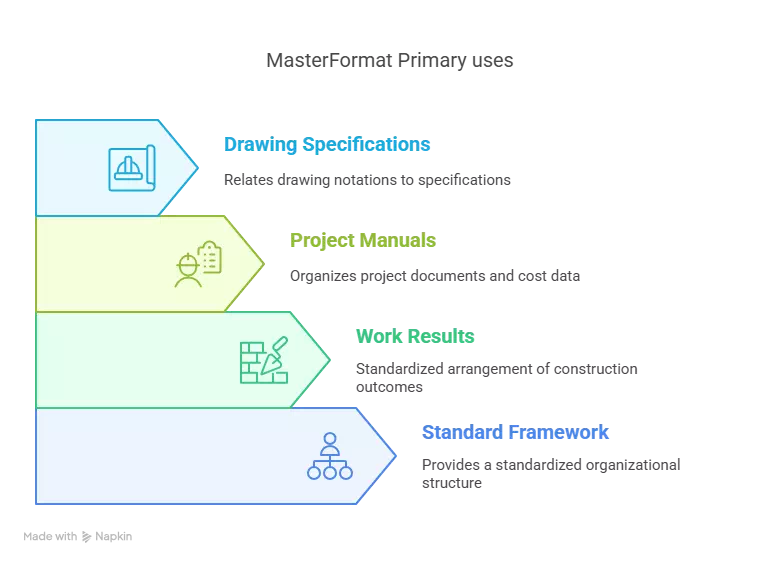
Construction Specifications Institute (CSI) MasterFormat® is a standard list of numbers and titles used for identifying work results and construction practices. Project manuals, detailed cost information, and the relationship between drawing notations and specifications are its primary uses. It provides a standard organizational framework and is a standardized arrangement of work results
Why MasterFormat?
MasterFormat serves as a fundamental standard for organizing construction information across the industry for several key reasons:
- Standardization and Organization: It provides a standard framework of numbers and titles for identifying work results and construction practices, used universally throughout the industry.
- Enhanced Communication: It improves the speed and quality of communication between construction project professionals, helping ensure correct and timely completion of work.
- Efficient Information Management: The hierarchical organization allows users to easily find and retrieve essential project information.
- Broad Applicability: Originally designed for commercial building construction, it has expanded to address heavy civil, roadway, process, and industrial construction projects.
- Versatility Throughout Project Lifecycle: Beyond project manuals, it’s used for organizing construction cost databases, collecting technical data, tagging drawing notations, organizing BIM objects, and supporting facility management.
- Industry Acceptance: With over 55 years of continuous refinement, it’s the most widely used system for organizing construction project information in North America.
- Future-Proof Design: The expansion to a six-digit numbering system in 2004 provided greater flexibility for future growth and adaptation.
Construction Specifications Institute (CSI) MasterFormat ultimately provides the essential structure needed to efficiently manage the vast amount of information in construction projects from initial design through facility management.

MasterFormat Hierarchy

Construction Specifications Institute (CSI) MasterFormat is organized in a hierarchical structure consisting of
1. Groups (Level 1)
- Two unnumbered groups:
- Procurement and Contracting Requirements Group
- Specifications Group
- Users cannot create new Groups
- All Groups should be listed in project manual table of contents, even if unused
2. Subgroups (Level 2)
- Groups are divided into unnumbered Subgroups
- Seven titled subgroups:
- Under Procurement and Contracting Requirements Group:
- Introductory Information
- Procurement and Contracting Requirements
- Under Specifications Group:
- General Requirements Subgroup
- Facility Construction Subgroup
- Facility Services Subgroup
- Site and Infrastructure Subgroup
- Process Equipment Subgroup
- Under Procurement and Contracting Requirements Group:
- Users cannot create new Subgroups
3. Divisions (Level 3)
- Divisions are the top level of the numbered taxonomy (Level 1)
- Fifty numbered divisions (00-49):
- Division 00: Entire Procurement and Contracting Requirements Group
- Divisions 01-49: Specifications Group
- Division 01: General Requirements
- Divisions 02-19: Facility Construction
- Divisions 20-29: Facility Services
- Divisions 30-39: Site and Infrastructure
- Divisions 40-49: Process Equipment
- Of the 49 Divisions in the Specifications Group, 34 are currently in use and 15 are reserved
- Each Division contains numbered Titles at Levels 2-4 (often called “sections” in project manuals)
- Division numbers form the first two digits of the MasterFormat number
- Users cannot create new Divisions or use reserved ones

Examples:
03 31 13 – Heavyweight Structural Concrete
- 03: Division 03—Concrete (Level 1)
- 31: Section for Structural Concrete (Level 2)
- 13: Specific type: Heavyweight Structural Concrete (Level 3)
- This number tells you it’s a concrete material specification (03), specifically for structural applications (31), and particularly heavyweight concrete (13).
07 52 16 – Styrene-Butadiene-Styrene Modified Bituminous Membrane Roofing
- 07: Division 07—Thermal and Moisture Protection (Level 1)
- 52: Section for Modified Bituminous Membrane Roofing (Level 2)
- 16: Specific type: SBS Modified Bituminous Membrane (Level 3)
- This number identifies a roofing system (07) that uses modified bituminous membranes (52), specifically the SBS type (16).
23 65 13 – Forced-Draft Cooling Towers
- 23: Division 23—Heating, Ventilating, and Air Conditioning (Level 1)
- 65: Section for Cooling Towers (Level 2)
- 13: Specific type: Forced-Draft Cooling Towers (Level 3)
- This number designates HVAC equipment (23), specifically cooling towers (65) of the forced-draft type (13).
26 24 16 – Panelboards
- 26: Division 26—Electrical (Level 1)
- 24: Section for Switchboards and Panelboards (Level 2)
- 16: Specific type: Panelboards (Level 3)
- This number identifies electrical equipment (26) from the switchboard/panelboard category (24), specifically standard panelboards (16).
32 92 23 – Sodding
- 32: Division 32—Exterior Improvements (Level 1)
- 92: Section for Turf and Grasses (Level 2)
- 23: Specific type: Sodding (Level 3)
- This number refers to site work (32), specifically landscaping with turf (92), using the sodding method (23) rather than seeding or other methods.
This hierarchical structure is based on work results rather than design disciplines or trades, providing a standardized framework for organizing construction information throughout the project lifecycle.
Summary
MasterFormat is a standardized organizational system for construction information.
- Provides a consistent framework of numbers and titles for identifying work results
- Helps construction teams communicate effectively and locate information efficiently
- Organizes content hierarchically through Groups, Subgroups, and Divisions
- Contains 50 numbered Divisions (00-49) covering all aspects of construction
- Includes detailed classifications within each Division for specific construction elements
- Primarily used to organize project manuals, cost information, and drawing notations
- Serves as a common language across the construction industry to ensure accurate and timely completion of work
- Includes a Keyword Index to help users navigate and find specific construction work results
The system’s standardized structure facilitates better teamwork and information management throughout the entire construction process. Contact us for expert advice.






0 Comments
Very clear